Crucible, as an important component of chemical equipment, is a container for melting and refining metal liquid and heating solid-liquid reactions. It is the basis for the smooth progress of chemical reactions.
Quartz ceramic crucibles are made of high-purity fused quartz. They feature a fine structure, low thermal conductivity, low thermal expansion coefficient, excellent thermal shock resistance, superior electrical properties, and chemical resistance. They are widely used in the glass processing industry, metallurgy, electronics, chemical industry, aerospace, and other fields. Generally, quartz ceramic crucibles are square or cylindrical.
Alumina crucibles, are commonly referred to as corundum crucibles when the alumina content exceeds 95%. Corundum crucibles are strong and resistant to melting, high temperatures, acids and alkalis, extreme cold and heat, and chemical corrosion. They are suitable for the anhydrous melting of weakly alkaline samples such as Na₂CO₃, but are not suitable for melting samples containing water. Alumina crucibles are available in a variety of sizes and shapes depending on the application.
Aluminum alloy crucibles are metal containers used to melt aluminum alloys. They are typically made of cast iron, cast steel, or special heat-resistant alloys (such as those containing nickel or chromium). Used as a melting tool, it heats solid aluminum alloys to a molten state and holds the temperature to facilitate pouring or die-casting.
Aluminum alloy crucible parameter reference:
| Specification | Al₂O₃ | SiO₂ | Fe₂O₃ | TiO₂ | CaO | MgO | K₂O | Na₂O |
|---|---|---|---|---|---|---|---|---|
| Content | >65% | <35% | <0.2% | <0.3% | <0.1% | <0.06% | <0.1% | <0.2% |
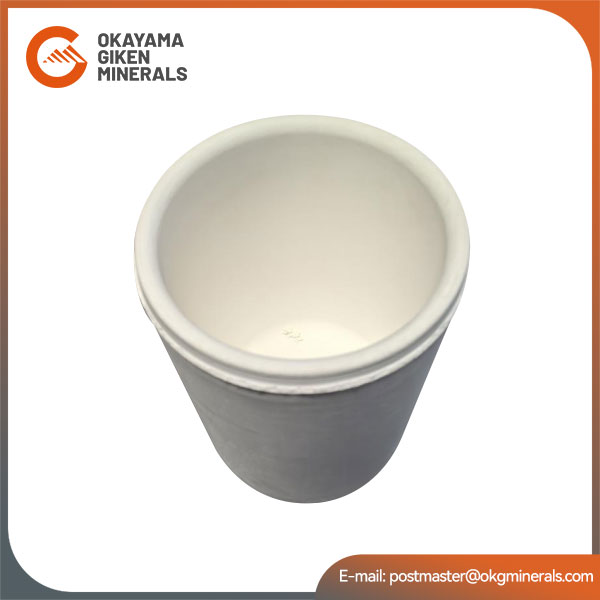
Common types of boron nitride include cubic boron nitride (C-BN) and pyrolytic boron nitride (P-BN). Boron nitride crucibles are typically composed of P-BN. P-BN ceramics offer excellent heat resistance, thermal stability, thermal conductivity, and high-temperature dielectric strength, making them ideal heat sinks and high-temperature insulators. P-BN crucibles are commonly used in metal and semiconductor smelting and can be used in vacuum at temperatures up to 1800°C.
Zirconium oxide has a higher melting point than zirconium and is one of the most refractory materials found in nature. Even when heated to 1900°C, zirconium oxide does not react with molten aluminum, iron, nickel, platinum, silicates, or acid slags. Therefore, zirconia crucibles can successfully melt precious metals such as platinum, palladium, ruthenium, and cesium, as well as their alloys.
Yttria ceramic is a high-performance ceramic with excellent heat and corrosion resistance and high-temperature stability. With a melting point exceeding 2400°C, yttria hardly reacts with some reactive metals (such as Ti, Al, Hf, and Nb) at high temperatures. This crucible has the potential to melt Ti and Ti alloys, or any oxygen-sensitive melting process. However, yttria's high melting point makes it difficult to process. Because yttria is inherently brittle, the crucible may crack if heated or cooled too rapidly.